TONIMOTO compares e-bikes on the published measurements that decide whether a bike fits a rider between 5’0″ and 5’5″. This page explains exactly where our numbers come from, what we do not do, and how to check our work.
What this site does
We compare manufacturers’ published specifications, we do not road-test bikes. Every measurement we print — standover height, minimum rider height, weight, battery capacity, motor output — is read off the manufacturer’s own product page or specification sheet and linked to its source. Where a manufacturer does not publish a figure, we write “not published” instead of estimating it. How we find these figures, and the mistakes we made along the way, is in our guide to reading an e-bike spec sheet.
That is a narrower claim than most e-bike sites make, and we think it is a more useful one. A reviewer who rides a bike for a weekend can tell you how it feels. They cannot tell you whether it will fit you, because they are not your height. Fit is decided by numbers, and those numbers are checkable.
The four measurements we care about
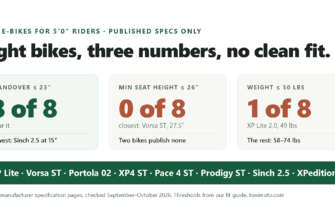
- Standover height — the height of the frame where you straddle it. If this exceeds your inseam, you cannot stand flat-footed over the bike at a stop. It is the single most important number for a short rider and the one most often unpublished. We collect every figure we can find in our standover height database.
- Manufacturer’s minimum rider height — the bottom of the range the brand itself will vouch for. Useful as a floor, but it is a marketing statement about the whole bike, not a measurement. When it conflicts with standover, we say so.
- Weight — decides whether you can lift the bike onto a rack, carry it up stairs, or pick it up after a fall. We print the manufacturer’s figure and, where published, the weight without the battery, because that is the number that matters when carrying.
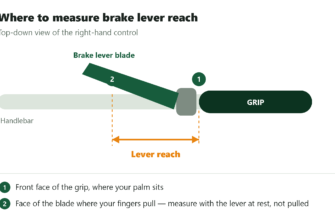
- Reach and control geometry — how far you stretch to the handlebars and whether you can operate the brake levers. See handlebar reach for petite riders.
How we source and check a number
- We open the manufacturer’s own product page and specification page for the exact model and frame size.
- We record the figure and the URL it came from. Third-party retailers, press releases and review sites are not accepted as sources for specifications.
- Where a manufacturer’s pages contradict each other, we use the specification sheet, state that the conflict exists, and name both numbers. This is not rare: as of July 2026, Tenways lists the CGO600 Pro’s torque as 45 Nm on its spec page and 40 Nm in its FAQ.
- Where a price is rendered by JavaScript and absent from the page source, we load the page in a browser and read the rendered price. Aventon’s site works this way.
- Prices are recorded with the date they were captured, because promotional pricing changes constantly.
What we do
- Link the source for every specification we print
- Write “not published” when a manufacturer does not publish something
- Name the frame size a measurement belongs to, since standover differs between sizes of the same bike
- Say when a model has been discontinued and what replaced it
- Re-check specifications when we update an article, and date the update
What we do not do
- We do not ride or physically test the bikes, and we do not claim to
- We do not invent star ratings, review counts, or scores
- We do not estimate a measurement a manufacturer has withheld
- We do not accept payment from a brand for placement, coverage, or a favourable conclusion
- We do not quote specifications from retailers or press coverage
How the Fit Score is calculated
The Fit Score is arithmetic, not opinion. It combines four published measurements into a score out of 10, weighted by how much each one decides whether a bike works for a rider between 5′0″ and 5′5″. Every input comes from the manufacturer’s own specification page. You can recalculate any bike’s score yourself from the tables below.
It is not a quality rating. A bike with a low Fit Score can be an excellent bike — it just is not built for our readers’ bodies. We do not score ride feel, build quality, or customer service, because we do not ride the bikes and cannot measure those.
1. Standover height — up to 40 points
The single measurement that decides whether you can stand flat over the frame at a stop. Inseams in our height band typically run 26″–29″, so the thresholds are set against that.
| 22″ or lower | 40 |
| 22.1″–24″ | 34 |
| 24.1″–26″ | 28 |
| 26.1″–28″ | 20 |
| 28.1″–30″ | 10 |
| Above 30″ | 4 |
If the manufacturer publishes no standover figure, the bike gets no Fit Score at all. We do not estimate it, and we do not quietly drop the criterion. Where a size range is published instead of a single number, we score the lower bound.
2. Stated minimum rider height — up to 25 points
How far into our band the manufacturer is willing to vouch for its own bike.
| 4′8″ or lower | 25 |
| 4′9″–4′10″ | 22 |
| 4′11″–5′0″ | 18 |
| 5′1″–5′2″ | 14 |
| 5′3″–5′5″ | 7 |
| Above 5′5″ | 0 |
3. Weight — up to 25 points
Whether you can lift the bike onto a rack, carry it up steps, or pick it up after a fall. We score the published full weight, not the weight without the battery.
| 40 lbs or less | 25 |
| 41–46 lbs | 20 |
| 47–50 lbs | 15 |
| 51–55 lbs | 10 |
| 56–60 lbs | 6 |
| Above 60 lbs | 3 |
4. Brake type — up to 10 points
Hydraulic discs need materially less hand force than mechanical ones, which matters if you have small hands. See our brake lever reach guide.
| Hydraulic disc | 10 |
| Mechanical disc | 4 |
| Rim brakes | 0 |
What the total means
Points are summed out of 100 and shown as a score out of 10. A score of 8.0 or above means the bike clears our band on the measurements that matter; 6.0–7.9 means it works with a caveat you should read; below 6.0 means the numbers are against you even if the bike is good.
What the Fit Score deliberately ignores
- Price. Affordability is a separate decision and we do not want a cheap bike scoring well on fit it does not have.
- Motor power, battery size, range. Real considerations, but they do not change whether the bike fits you.
- Ride quality, comfort, reliability. We do not ride the bikes, so we do not score them.
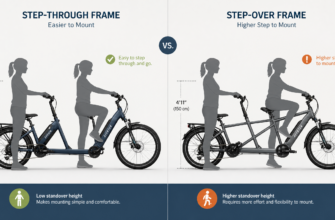
- Frame style labels. “Step-through” is a marketing term with no measurement behind it. Standover is the measurement.
If a manufacturer publishes a corrected figure, the score changes with it. If you think a score is wrong, check it against the tables above and tell us — the arithmetic is public precisely so it can be challenged.
How we choose which bikes to cover
A bike qualifies for a recommendation only if the manufacturer publishes a minimum rider height at or below 5’5″, or a standover figure low enough to clear a typical inseam in our range. That rule removes popular models: the Tenways CGO600 Pro is a well-regarded commuter, but Tenways states a 5’5″ minimum rider height, which puts it at the very top of our band rather than inside it, so we do not recommend it to short riders.
We also cover bikes that fail, when they are widely recommended to short riders anyway. Knowing that the Aventon Pace 4 Step-Through weighs 58.2 lbs is more useful than not mentioning it.
Corrections
We publish specification errors as corrections rather than silently editing them. If you find a number on this site that does not match the manufacturer’s current page, tell us and we will check it and fix it — contact us here. Manufacturers change specifications between model years without renaming the model, so this happens.
How we make money
TONIMOTO earns commission when a reader buys through some of our links, at no extra cost to the reader. Affiliate relationships do not influence which bikes we recommend or what we say about them, and we recommend bikes from brands we earn nothing from. Full terms on our affiliate disclosure page.
Who writes this
TONIMOTO is written and maintained by Tim Tomson. The site exists because size charts fail short riders: a bike sold as fitting “5’1″ and up” can have a top tube most 5’1″ riders cannot clear. Everything here is built around measurements you can verify yourself against the manufacturer’s page. More about the site.