Most advice for short riders ends with “get a stem riser” or “try shorter cranks” and stops there. It never says which bikes those parts actually fit, or which fit problem each one solves. This page does both. Every compatibility figure below comes from the manufacturer’s own specification page, checked in September 2026, and where a maker does not publish a figure we say so rather than guess. We have not fitted these parts ourselves; this is a reading of published specifications, ours and the part makers’.
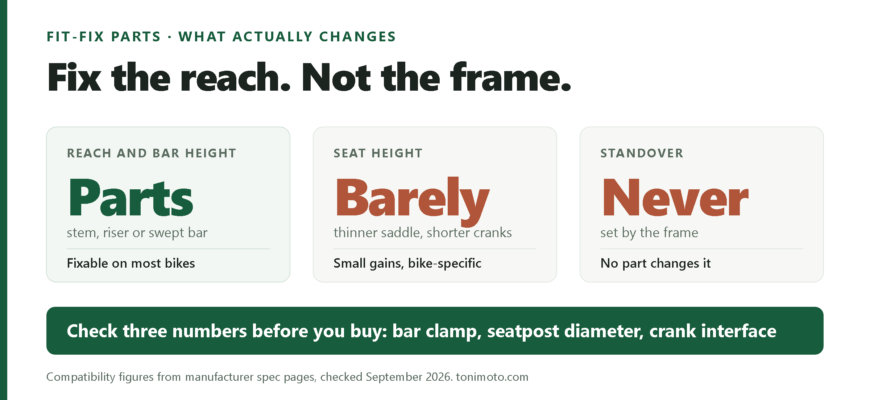
Start with the one rule that saves the most money: a part can change where your hands and saddle sit. No part changes where the frame sits. If your problem is standover, you need a different bike, and our standover height database is the place to pick one. If your problem is reach or, to a limited degree, seat height, read on.
The three numbers to check before you buy anything
Every part on this page attaches to one of three interfaces, and each has a diameter or a standard that has to match. Bike makers publish these unevenly, which is the whole reason the table further down exists.
- Handlebar clamp diameter. The bar’s thickness where the stem holds it, almost always 31.8 mm or 25.4 mm. A new bar or stem must match. Ride1Up and Aventon publish it (31.8 mm on all four of their bikes we track); Lectric and Tenways do not.
- Seatpost diameter. 27.2, 30.9 and 31.6 mm are the common sizes, and a post that is off by a tenth of a millimetre will not fit or will not hold. Aventon and Ride1Up publish it; Lectric and Tenways do not.
- Crank interface. How the crank arm attaches to the axle. Square taper is the common one on bikes in this price range and the one that aftermarket short cranks are made for. Only Aventon publishes it among the brands we track.
Lever 1: handlebar height — stem riser or adjustable stem
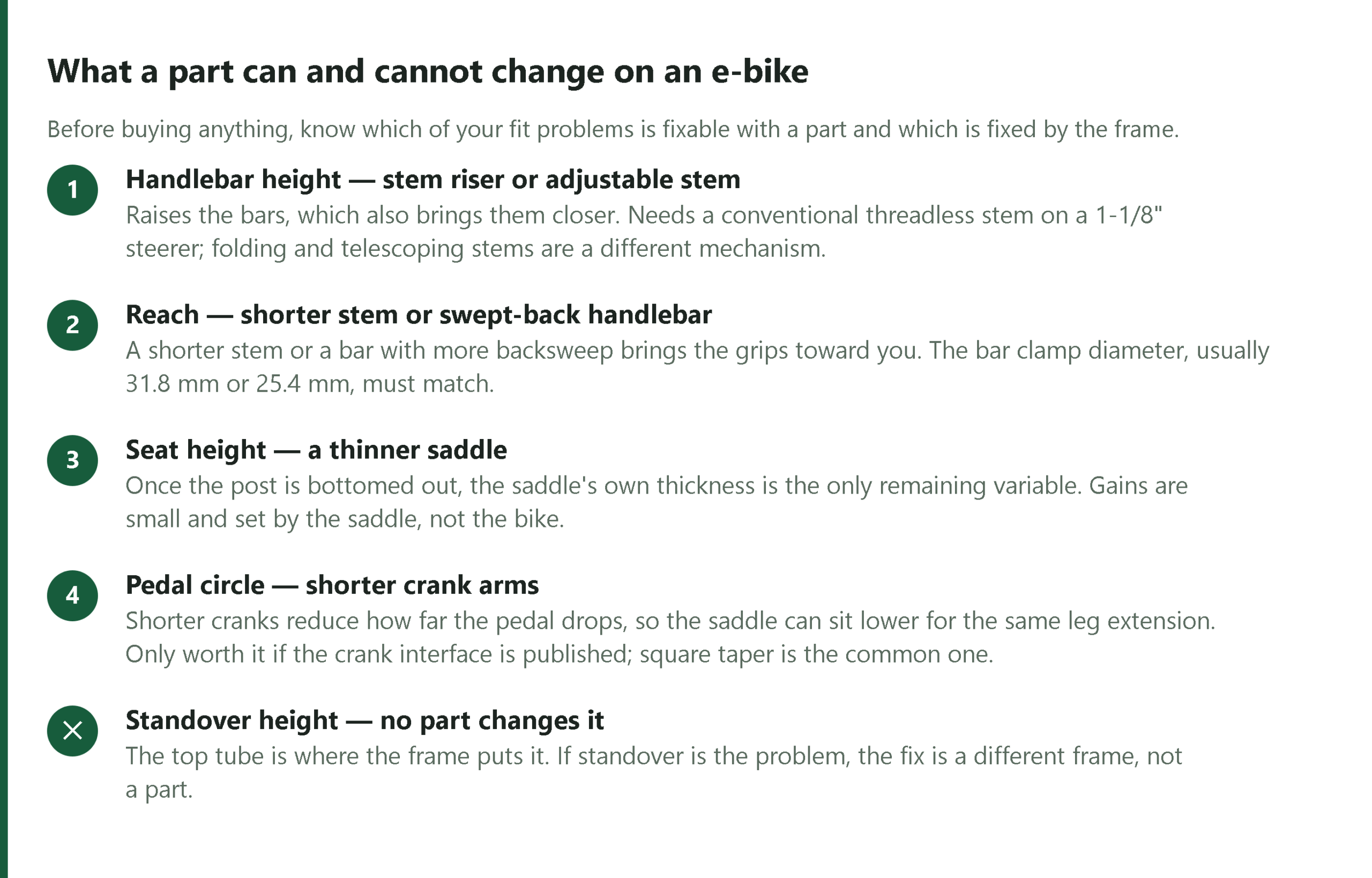
What it fixes: bars that are too low, which forces you to lean forward and effectively lengthens the reach. Raising the bars also brings them slightly toward you, because the steerer tube is angled back.
What it needs: a conventional threadless stem clamped to a 1-1/8″ (28.6 mm) steerer. A stem riser is a sleeve that extends that steerer upward so the stem clamps higher; an adjustable stem replaces the stem with one whose angle you set. Both are listed on Amazon by their steerer and bar-clamp sizes, and both come with a warning worth taking seriously: raising the bars by several inches can leave brake and shifter cables too short.
Where it does not apply: folding bikes. The Lectric XP Lite 2.0 uses a telescoping folding stem and the XP4 a folding stem with an adjustable height; both publish a handlebar-height range (41″–46″ and 45″–48″ respectively), so the height lever is built in and a riser has nothing to attach to. The Ride1Up Portola 02 uses a folding stem with a fixed 285 mm length and 12° rise. The Aventon Sinch 2.5 publishes a 28.6 mm steerer but does not publish the stem, so confirm with Aventon before ordering anything. The Ride1Up Roadster V3 is the opposite case: it already ships with a 0–90° adjustable 80 mm stem, so the first thing to try costs nothing.
Stem risers for a 28.6 mm steerer on Amazon → · Adjustable stems, 31.8 mm clamp →
Lever 2: reach — shorter stem or swept-back handlebar
What it fixes: a stretched-out position, the shoulder and neck strain we cover in the handlebar reach guide. Reach is the one fit dimension that parts change substantially.
Two ways to do it. A shorter stem moves the whole bar toward you by the difference in stem length: swapping an 80 mm stem for a 40 mm one brings the grips about 40 mm (1.6″) closer, less any change in angle. A swept-back bar keeps the stem and curves the grips back toward you instead; bars are listed by their backsweep angle, and more sweep means grips closer to your body and a more upright wrist. Either way the bar clamp diameter has to match your stem, and a swept bar also has to leave room for your display, throttle and brake levers, which sit on the straight section next to the stem.
Where the numbers are known: the Ride1Up Portola 02 (31.8 mm clamp, 650 mm wide, 6° sweep, 170 mm rise), the Roadster V3 (31.8 mm, 680 mm, 10° sweep, 40 mm rise), the Aventon Sinch 2.5 and Soltera 2.5 (31.8 mm, 620 mm). On those four, a 31.8 mm swept-back bar is a like-for-like swap. Lectric publishes a 25″ bar width for both XP models but not the clamp diameter, so measure the bar at the stem before ordering. Tenways publishes nothing about the CGO800S cockpit beyond “riser handlebar”.
A note on the two Lectrics: their published reach is a range — 15″–18″ on the XP4, 19″–20.5″ on the XP Lite 2.0 — because the telescoping stem changes it. Use the bottom of that range before buying a bar. On the XP Lite the bottom of the range is still 19″, which is why it is the Lectric a short-armed rider should think twice about, as our XP Lite vs XP4 comparison explains.
Short stems, 31.8 mm clamp → · Swept-back handlebars, 31.8 mm →
Lever 3: seat height — a thinner saddle
What it fixes: very little, honestly, and it is worth being clear about why. The minimum seat height a maker publishes is measured with the seatpost pushed all the way down. At that point the only thing left between the frame and your body is the saddle itself. A lower-profile saddle sits closer to the post, so the saddle top drops by the difference in the two saddles’ stack heights. Saddle makers sometimes list that height; bike makers do not, so we cannot put a number on the gain for any specific bike. Expect it to be small.
The seatpost is the bigger lever, on one bike. A suspension seatpost sits taller than a rigid post by the height of its own mechanism. The Aventon Sinch 2.5 ships with a suspension post (30.9 mm, 350 mm long), so replacing it with a rigid 30.9 mm post is a real, if unquantified, way to bring the saddle down on that bike. Aventon does not publish the mechanism height, so we cannot tell you by how much. The Soltera 2.5 uses a 27.2 mm post and the two Ride1Ups 31.6 mm; Lectric and Tenways do not publish the size.
Low-profile saddles on Amazon →
Lever 4: pedal circle — shorter crank arms
What it fixes: the gap between the seat height you need and the seat height the bike allows. Shorter cranks do not lower the saddle. They lower how high the saddle needs to be, because the pedal at the bottom of the stroke sits higher and your leg does not have to reach as far. Swap 170 mm arms for 152 mm and the bottom of the pedal stroke rises by 18 mm, about 0.7″; for the same leg extension the saddle can come down by about the same amount, which on a bike whose published minimum is an inch above your target is the difference between a toe-touch and a foot down. Shorter cranks also reduce pedal strikes in corners, which is why they are common on mountain bikes.
What it needs: the same crank interface as your bike. Aftermarket 152 mm sets are widely sold for square taper axles. Among the brands we track only Aventon publishes the interface, and it is square taper on both the Sinch 2.5 and the Soltera 2.5, each with 170 mm arms — the same length Aventon fits to a bike it rates from 4′11″. Two cautions before ordering for either. First, the right-hand arm carries the chainring spider: the Sinch 2.5 runs a 48-tooth ring on a 130 mm bolt circle, so either buy arms that accept that ring or accept the new ring that comes with the set and the gearing change that goes with it. Second, Aventon’s torque sensor lives in the bottom bracket, not the crank, so it stays put — but a shop should torque square-taper arms, because a loose one ruins the axle.
Where it does not apply: belt-drive bikes. The Lectric XP Lite 2.0 and the Tenways CGO800S both use a Gates belt, whose front sprocket is part of the crankset, so a generic crank set from Amazon is not a fit; a belt-compatible crank is a shop job. The Lectric XP4 and the two Ride1Ups do not publish crank length or interface at all, so we cannot say what fits them, and neither can a product listing.
152 mm square-taper crank sets on Amazon →
Compatibility table: what each bike publishes
Every cell is a manufacturer figure. Not published means we read the full specification page and the figure is absent; it does not mean the part will not fit, only that the maker has not told you.
| Bike | Bar clamp / width | Stem | Seatpost | Crank length / interface | Stem riser? | Swept bar / short stem? | 152 mm cranks? |
|---|---|---|---|---|---|---|---|
| Lectric XP Lite 2.0 | Not published / 25″ | Telescoping, folding; bar height 41″–46″ | Not published | Not published; Gates belt | No: built-in telescoping | Measure clamp first | No: belt sprocket on crank |
| Lectric XP4 | Not published / 25″ | Folding, adjustable; bar height 45″–48″ | Not published | Not published | No: built-in adjustment | Measure clamp first | Interface not published |
| Ride1Up Portola 02 | 31.8 mm / 650 mm, 6° sweep | Folding, 285 mm, 12° rise, 31.8 mm | 31.6 × 350 mm | Not published | No: folding stem | Yes: 31.8 mm bar | Interface not published |
| Ride1Up Roadster V3 | 31.8 mm / 680 mm, 10° sweep | Adjustable 0–90°, 80 mm, 31.8 mm | 31.6 × 350 mm | Not published | Not needed: stem adjusts | Yes: 31.8 mm bar and stem | Interface not published |
| Aventon Sinch 2.5 | 31.8 mm / 620 mm | Not published (28.6 mm steerer) | 30.9 × 350 mm, suspension | 170 mm / square taper | Ask Aventon: folding stem | Yes: 31.8 mm bar | Yes: square taper, 130 BCD ring |
| Aventon Soltera 2.5 | 31.8 mm / 620 mm | Not published | 27.2 mm | 170 mm / square taper | Likely: conventional stem, confirm steerer | Yes: 31.8 mm bar | Yes: square taper |
| Tenways CGO800S | Not published (“riser handlebar”) | Not published | Not published | Not published; Gates CDX belt | Unknown | Measure clamp first | No: belt sprocket on crank |
What this means, bike by bike
- Aventon Sinch 2.5 and Soltera 2.5 are the bikes where parts do the most, simply because Aventon publishes the most: bar clamp, seatpost and crank interface are all known, and both bikes ship with 170 mm cranks that a 152 mm square-taper set can replace. On the Sinch, a rigid seatpost in place of the suspension post is the second lever.
- Ride1Up Roadster V3: adjust the stem you already have before buying anything. Then a swept 31.8 mm bar if reach is still long. The 33.46″ minimum seat height on the Low-Step frame is a frame limit, not a part problem; see our Roadster V3 geometry read.
- Ride1Up Portola 02: the folding stem rules out risers and adjustable stems, so reach is a handlebar question, and the bar already has 170 mm of rise. Seat height starts at a published 30.5″; our Portola 02 geometry read covers what that means at each height.
- Lectric XP Lite 2.0 and XP4: use the telescoping stem’s full range first; it is the part other bikes make you buy. Beyond that, Lectric publishes too little for us to name a compatible bar or crank, and the XP Lite’s belt drive rules out generic cranks.
- Tenways CGO800S: Tenways publishes no cockpit or crank dimensions and the bike is belt-driven. Its 430 mm standover does the work here, not parts.
Before you buy: a short checklist
- Name the problem. Reach and bar height are part problems. Seat height is mostly a frame problem with a small part component. Standover is entirely a frame problem.
- Get the interface figure from the maker’s page, not from a forum. If it is not published, measure the bike with calipers or ask the maker in writing before ordering.
- Read the part listing for its own numbers: steerer diameter, clamp diameter, seatpost diameter, crank interface and length. If the listing does not state them, it is the wrong listing.
- Budget for cables. Raising or changing bars can leave brake lines and shifter cables short, and on an e-bike the display and throttle wiring too.
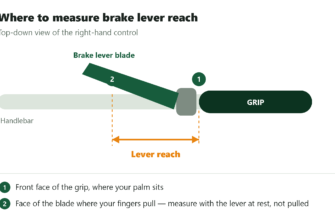
- Our step-by-step adjustment guide covers the free adjustments to make before any of this: saddle height and tilt, saddle fore-aft, stem angle, and brake lever reach.
The Amazon links on this page go to search results for the part type described, so you can compare listings and check the sizes yourself. At the time of writing we hold no Amazon affiliate relationship and earn nothing from these links; if that changes we will update this page and our affiliate disclosure.
Questions
Can a stem riser make an e-bike fit a short rider?
It can fix bars that are too low and slightly shorten the reach, on a bike with a conventional threadless stem on a 1-1/8″ steerer. It does nothing for standover or seat height. Folding e-bikes such as the Lectric XP Lite 2.0, XP4 and Ride1Up Portola 02 use folding or telescoping stems that a riser does not attach to; the Lectrics already adjust bar height across a published range.
Do shorter cranks lower the seat height on an e-bike?
Not directly. They lower how high the saddle needs to be, because the pedal at the bottom of the stroke sits higher. Going from 170 mm to 152 mm arms raises the bottom of the stroke by 18 mm, so the saddle can sit about 0.7″ lower for the same leg extension. They only fit if the crank interface matches; among the brands we track only Aventon publishes it, and it is square taper.
Which e-bikes for short riders publish their crank length?
Of the seven bikes in our compatibility table, only Aventon’s Sinch 2.5 and Soltera 2.5 publish it: 170 mm on both, with a square-taper interface. Lectric, Ride1Up and Tenways publish no crank length for the XP Lite 2.0, XP4, Portola 02, Roadster V3 or CGO800S.
Can you lower the standover height of an e-bike with parts?
No. Standover is the height of the frame’s top tube and no stem, saddle, seatpost or crank changes it. If standover is the problem, choose a different frame; our standover height database lists every published figure we can source.
What handlebar diameter do the Lectric XP Lite and XP4 use?
Lectric publishes a 25″ handlebar width for both bikes but does not publish the bar clamp diameter on its product pages. Measure the bar where the stem clamps it, or ask Lectric, before ordering a replacement bar.