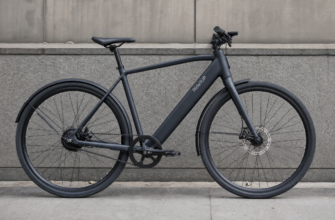
Ride1Up publishes something for the Roadster V3 that almost nobody else in this price class publishes: a complete geometry table, covering all three frames, including the two numbers that decide whether a short rider can actually live with a bike. Most brands give you a height range and a standover figure and stop there.
This page reads that table for riders between 5′0″ and 5′5″. We have not ridden this bike — this is an analysis of Ride1Up’s published specifications, checked at the source in July 2026. See our review methodology for what that does and does not mean.
The published geometry, all three frames
The Roadster V3 is sold as a Low-Step frame and a standard frame in two sizes. Low-Step is a frame, not a size: there is no “Low-Step Large”. All three weigh 40 lbs and carry the same 300 lb capacity.
| Measurement | Low-Step | Standard (Medium) | Standard (Large) |
|---|---|---|---|
| Stated rider height range | 5′2″–5′11″ | 5′5″–5′9″ | 5′9″–6′4″ |
| Standover height | 23.2″ (589 mm) | 30.5″ (775 mm) | 31.5″ (800 mm) |
| Minimum seat height | 33.46″ (850 mm) | 35.04″ (890 mm) | 37.4″ (950 mm) |
| Maximum seat height | 42.13″ (1070 mm) | 44.09″ (1120 mm) | 46.46″ (1180 mm) |
| Handlebar reach | 15.9″ (404 mm) | 16.53″ (420 mm) | 17.08″ (434 mm) |
| Top tube length | 21.88″ (556 mm) | 22.71″ (577 mm) | 23.66″ (601 mm) |
| Stack | 23.26″ (591 mm) | 23.66″ (601 mm) | 24.09″ (612 mm) |
| Handlebar height | 39.37″ (1000 mm) | 40.16″ (1020 mm) | 40.55″ (1030 mm) |
| Weight | 40 lbs | 40 lbs | 40 lbs |
The frame decision is worth seven inches
Because the same model is sold in both frames with identical components, the Roadster V3 isolates what a low-step frame actually buys you — something a cross-brand comparison can never do cleanly.

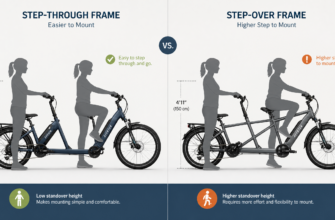
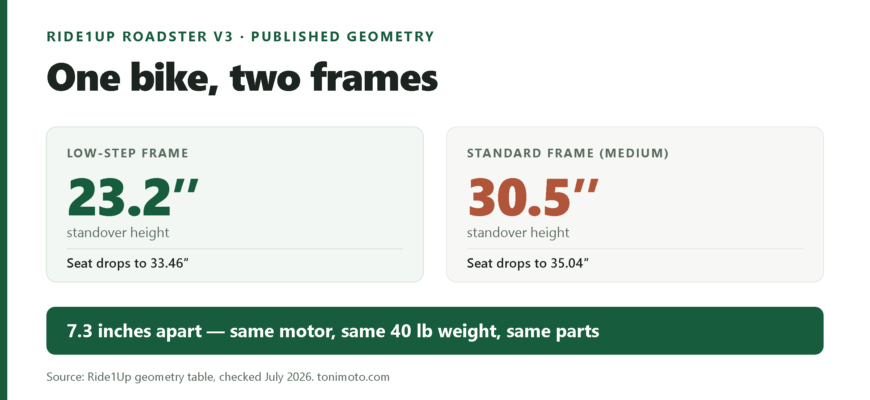
The gap between the Low-Step and the standard Medium is 7.3 inches. For comparison, going down a size on the standard frame — Large to Medium — buys one inch. If you are in our height range and considering this bike, the frame choice is the decision; the size choice is a rounding error.
At 23.2″, the Low-Step frame sits fourth-lowest in our standover height database, behind the Aventon Sinch 2.5, the Tenways CGO800S and the Lectric XP Lite — and it is the lowest of any full-size 700C bike we have specifications for.
The catch: it clears the frame but not the ground
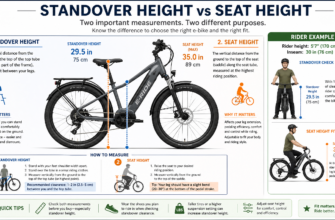
Standover answers one question — can you straddle the bike. It says nothing about whether you can put a foot down while seated, and on this bike the two answers point in opposite directions.
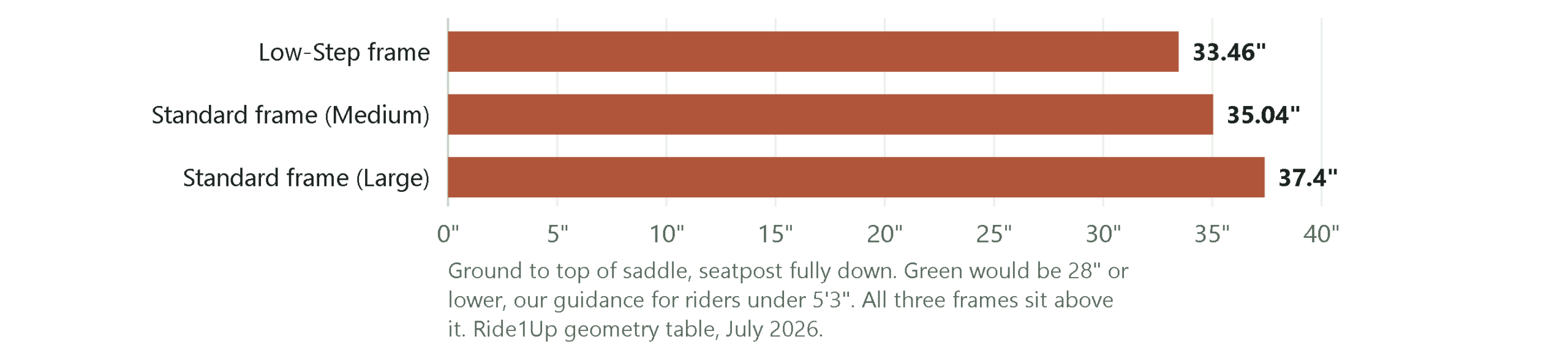
With the seatpost all the way down, the saddle on the Low-Step frame is 33.46″ above the ground. Our fit guide puts the target seat height for a rider at 5′5″ — the top of our range — at 30″–31.5″. The lowest this bike goes is above the target for every height this site covers.
That is not a defect. The Roadster V3 is a road-style bike, designed to be ridden with the leg near full extension and dismounted forward off the saddle, which is correct technique and how most drop-bar and flat-bar road bikes work. But it is the opposite of what “fits from 5′2″” suggests to someone who is nervous at intersections. If your requirement is putting a foot down without leaving the saddle, no adjustment fixes this: a published minimum is a hard floor.
Reach, and why one inch matters here
Ride1Up publishes handlebar reach directly, as do Lectric and Aventon — though Lectric quotes a range because its stem telescopes, which is not the same kind of number. The Low-Step frame is 15.9″, about 1.2″ shorter than the standard Large. No manufacturer publishes a recommended reach for a given rider height, so the number is only useful comparatively — but combined with the lowest stack of the three frames, the Low-Step is the least stretched-out of the family.
Low-Step against the standard frame, round by round
Every number below is published by Ride1Up for the same model. The standard frame is represented by the Medium, because that is the size a rider in our range would be pointed at.
Round 1 · Frame clearance
Low-Step, by 7.3 inches. This is the largest single fit difference available on this bike, and it is chosen at checkout. No component swap later gets it back.
Round 2 · Getting a foot down
Low-Step, but read the small print. It wins by an inch and a half and still sits above our target seat height for every rider up to 5′5″. Neither frame lets you sit and put a foot flat on the ground.
Round 3 · Cockpit reach
Low-Step, narrowly. Six tenths of an inch, plus the lowest stack of the three frames. Small on paper, but reach stacks with stem length and bar sweep, and it is the difference short-torso riders feel first.
Round 4 · Who the maker vouches for
Low-Step. The standard frame starts at the very top of our height band. A rider at 5′2″ is outside the range Ride1Up itself will stand behind.
Round 5 · Weight and parts
Dead heat, and that is the point. Nothing else changes between these two bikes. Everything the frame gives you is free of any trade in weight, power or braking — which is what makes this an unusually easy decision.
Who this bike fits
- Good fit: riders around 5′2″–5′5″ who want the lightest bike in this class, are comfortable coming forward off the saddle at stops, and value a genuinely low frame for mounting and dismounting.
- Wrong bike: riders who need to sit and touch the ground at every stop, and riders below about 5′2″ — Ride1Up’s own range starts there, and the seat height confirms it.
- Skip the standard frame entirely if you are in our height band. At 30.5″ standover it gives up the bike’s single biggest advantage.
Put through our Fit Score — a published formula, not an opinion — the two frames land in different worlds. Same bike, same parts, same price class.
Thirty-seven points separate them, and every one of those points comes from the frame. It is rare to be able to say that about two bikes with the same name.
Questions
Is the Ride1Up Roadster V3 good for short riders?
The Low-Step frame is, with one caveat. Its 23.2″ standover is among the lowest published for any full-size e-bike, and at 40 lbs it is the lightest bike we have specifications for. The caveat is the 33.46″ minimum seat height, which is above the target seat height for riders up to 5′5″. It suits riders who are comfortable dismounting forward off the saddle rather than sitting with a foot down.
What is the difference between the Roadster V3 Low-Step and Medium?
They are different frames, not different sizes. The Low-Step publishes a 23.2″ standover against 30.5″ for the standard Medium — a 7.3″ difference — with the same 40 lb weight and components. The Low-Step also has a slightly shorter reach at 15.9″ versus 16.53″.
What is the minimum seat height on the Roadster V3?
Ride1Up publishes 33.46″ (850 mm) for the Low-Step frame, 35.04″ (890 mm) for the standard Medium and 37.4″ (950 mm) for the standard Large, measured from the ground to the top of the saddle with the seatpost fully lowered.
Can a 5′0″ rider ride the Roadster V3?
Ride1Up’s stated range starts at 5′2″, and the published seat height supports that rather than contradicting it. We would not recommend it below 5′2″. Riders at 5′0″–5′1″ should look at the models in our under 5′1″ guide instead.