Every e-bike brand publishes a spec sheet, and almost none of them publish the same spec sheet. The three numbers that decide whether a bike fits a rider between 5′0″ and 5′5″ — standover height, minimum seat height and weight — go by different names from brand to brand, sit in different places on the page, and sometimes measure different things under the same name. We have read the spec pages of five brands and twenty-five models to build our standover and seat height databases. This is what we learned about reading them, including the mistakes we made along the way.
We do not ride or measure these bikes; everything here comes from the manufacturers’ own pages, checked between July and October 2026. Our review methodology explains how we turn these numbers into a Fit Score. Affiliate disclosure →
Rule 1: the number you want is often collapsed
The most useful fit figures are rarely in the headline spec list. They live in a size guide, a geometry table or an accordion that opens only when you click it, and some brands keep them on a different page altogether.
| Brand | Where the fit figures are |
|---|---|
| Lectric | A “Size Guide” block on each product page: standover, seat to ground, handlebar reach and height, rider height, weight with the battery removed. |
| Ride1Up | A lettered geometry table (A–O) further down each product page, with one column per frame or build, in inches with a millimetre conversion. |
| Aventon | A collapsed “Geometry” section on the product page with a lettered table (A–N). On the Pace 4 Step-Through we missed it for two months: the standover was there the whole time. |
| Tenways | Not on the product page. Frame geometry for the CGO800S is on a separate model page under /pages/, under a “Specs” tab. |
So before you conclude that a brand “does not publish” a number, open every collapsed section on the product page, look for a size guide or geometry tab, and check whether the brand has a separate model page. Then search the page for the names in the next sections. We now apply that rule to ourselves: we do not write “not published” until every section has been opened.
Rule 2: the same measurement has different names
Minimum seat height
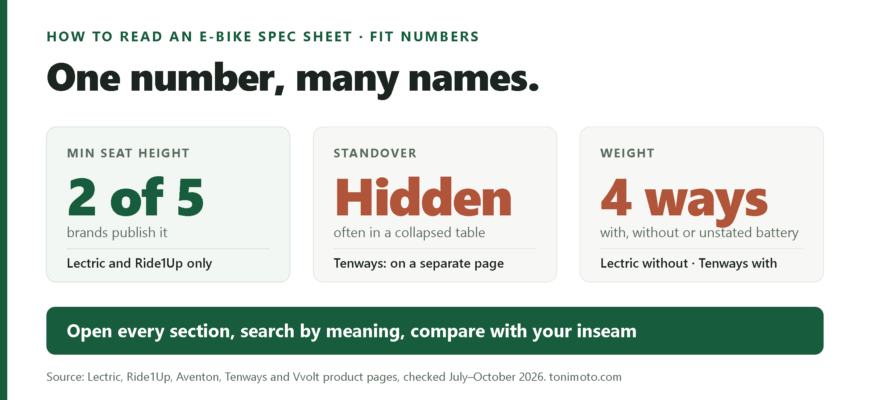
This is the lowest the saddle can go, and it decides whether you can touch the ground while seated. Only two of the five brands we track publish it, and neither calls it “minimum seat height” in the same way:
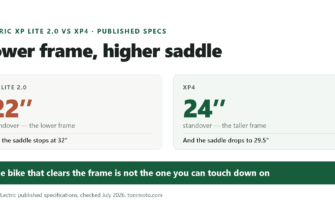
- Lectric: “Seat to Ground”, given as a minimum and maximum (29.5″ and 42″ on the XP4).
- Ride1Up: “B – Minimum Seat Height” in the geometry table, next to “A – Maximum Seat Height” (27.5″ on the Vorsa ST).
- Aventon: not published. Its tables list “Seat Tube Length” and “Seat Tube Angle”, which are frame dimensions. Neither is the seat height, and you cannot work the seat height out from them without the seatpost and saddle dimensions.
- Tenways: not published; the CGO800S table covers the frame only.
In July we wrote that no brand publishes this figure. That was wrong, and it was wrong because we searched for the phrase “minimum seat height” instead of the meaning. Search for “seat to ground”, “saddle height” and “seat height” too.
Standover height
Standover is the height of the frame where you straddle it. Lectric and Aventon call it “Stand Over Height”, Ride1Up “C – Stand-over Height”, Tenways “Standover” (row H). Watch the units and the rounding: Aventon lists the Pace 4 Step-Through’s standover as 430 mm and rounds it to 16″, but 430 mm is 16.9″. When a page gives both, trust the millimetres. Some brands give a range per size rather than one number (the Aventon Soltera 2.5 in size S: 29–31″).
Reach
Here the same word means three different things, so reach figures cannot be compared across brands:
- Lectric “Handlebar Reach” is a range, because the stem telescopes (15″–18″ on the XP4).
- Ride1Up “M – Handlebar Reach” is one figure per frame (14.8″ on the Vorsa ST, 16″ on the Portola 02).
- Aventon “J – Reach” is frame reach, a horizontal measurement of the frame itself, not of the handlebars. It is a perfectly good number, just not the same one.
Compare reach within a brand, not across brands. Our handlebar reach guide covers what to look for.
Rule 3: weight may or may not include the battery
The battery on these bikes weighs 6 to 10.5 lbs, so whether it is in the published weight matters. Four of the brands we track do it four different ways:
| Brand | What the published weight means |
|---|---|
| Lectric | Weight without the battery, with the battery listed separately. “Total bike weight is 62lbs without the battery installed” on the XP4, whose battery is 7 lbs: 69 lbs as ridden. |
| Tenways | Net weight with the battery, without accessories, and a stated tolerance of ±3–5%. The only brand we track that gives a tolerance. |
| Aventon | A weight and a separate battery weight, without saying whether the first includes the second. |
| Ride1Up | “Bike Weight”, sometimes with a note about the setup (“gravel setup” on the Roadster V3), but not about the battery. |
Lectric and Tenways define the number in opposite ways, and Aventon and Ride1Up do not define it at all. Within one brand, weights compare fairly. Between brands, treat a gap of a few pounds as noise. In our tables we add Lectric’s battery back in, because the bike you lift has a battery in it. Even then, check the battery figure on the page you are buying from: Lectric’s own pages for the XP Lite 2.0 gave us both 7 lbs and 8 lbs for the same battery.
Rule 4: the rider height range is a claim, not a measurement
“Fits riders 4′8″–6′2″” is the brand’s statement about who can ride the whole bike. It is useful as a floor: we do not recommend a bike below the height its maker gives. But it can disagree with the brand’s own geometry, and when it does, the geometry is the more specific number.
- Lectric rates the XP Lite 2.0 from 4′8″, but its saddle goes no lower than 32″. A 4′8″ rider will clear the 22″ frame and stop by standing over it, not by sitting.
- Aventon rates the Soltera 2.5 in size S from 5′1″, with a 29–31″ standover that most 5′1″ riders cannot straddle flat-footed.
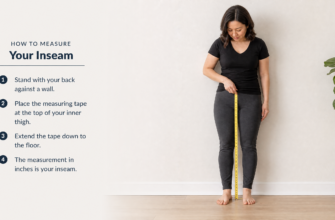
Read the range, then check it against standover and, where it exists, minimum seat height. Our measuring guide shows how to get the one number of your own you need for that: your inseam.
Rule 5: frame names and builds are not measurements
“Step-through”, “low-step” and “ST” describe the shape of the frame, not a number. Three examples from published tables:
- The Lectric XP4 Step-Thru has a 19″ standover against 24″ on the Step-Over, but both frames share the same 29.5″ minimum seat height. We compared them line by line in XP4 Step-Thru vs Step-Over.
- On the Ride1Up Prodigy V2 ECO, the ST frame’s minimum seat height is 0.2″ higher than the XR frame’s.
- On the Ride1Up Vorsa, the ST frame does sit lower, by almost four inches, and the same ST geometry is shared by three builds (Lite, standard and FT) that weigh 61, 65 and 72 lbs.
Builds and battery options change weight and price without changing the frame. The Ride1Up Portola 02 page sells the Portola 02 at $995 and the lighter Portola Lite from $895 on the same geometry; we once quoted the Lite’s price next to the 02’s weight. Make sure the price, weight and frame you are reading all belong to the same variant.
Rule 6: models change under the same name, and some disappear
In 2026 alone, four models we track were replaced by successors, and others changed specs without a new name. The original Ride1Up Portola gave way to the Portola 02, which publishes a standover its predecessor never did. Lectric’s XP Lite 2.0 went from a 7 lb to an 8 lb battery on one of its pages. Ride1Up’s Prodigy V2 page now opens as the Prodigy V2 ECO. A spec you read last season, on a forum or in a review, may describe a bike that is no longer sold. Check the date on whatever you are reading, including this page.
A checklist for any spec sheet
- Open every collapsed section, size guide and geometry tab on the product page. Check for a separate model page.
- Find standover. Prefer millimetres if the page gives both.
- Find minimum seat height under any of its names: seat to ground, minimum seat height, saddle height. If it is not there after step 1, it is genuinely not published.
- Find out whether the weight includes the battery. If the page does not say, assume it might not.
- Read reach only against the same brand’s other bikes.
- Check that the frame, build and battery you are reading match the one you would order.
- Compare standover and seat height with your inseam, not your height.
Or skip the hunting: our standover database and minimum seat height database collect every figure we have found, with links to the source pages. We earn affiliate commissions on some of the bikes we cover, and we do not take payment for placement. Use our pages to narrow a shortlist, then confirm the numbers on the manufacturer’s page before you buy.
Questions
Where do I find the minimum seat height of an e-bike?
In the size guide or geometry table on the product page, usually collapsed. Lectric calls it “Seat to Ground” and Ride1Up “B – Minimum Seat Height”. Aventon and Tenways do not publish it; a seat tube length is a frame dimension, not the seat height.
Does e-bike weight include the battery?
It depends on the brand. Lectric publishes weight without the battery and lists the battery separately; Tenways publishes net weight with the battery; Aventon and Ride1Up do not say. Within one brand the figures compare fairly; across brands, treat small differences as noise.
Is the rider height range on an e-bike accurate?
It is the manufacturer’s claim about the whole bike, and it can be more generous than the geometry. The Lectric XP Lite 2.0 is rated from 4′8″ but its saddle goes no lower than 32″. Check the standover and minimum seat height against your inseam.
Can I compare handlebar reach between brands?
Not reliably. Lectric publishes a range from a telescoping stem, Ride1Up a single handlebar reach figure, and Aventon a frame reach measured on the frame itself. Compare reach within one brand.